True Rest Made Simple: 10-Min Micro-Rest + 5-in-1 Kit

True rest isn’t the same as “taking a break”
True rest is more than pausing your to-do list. It’s the body getting clear cues of safety—slower breathing, softer muscles, fewer worry loops, and a nervous system that can finally downshift. When life is busy, “rest” often turns into distraction (scrolling, snacking, bingeing) that numbs for a moment but doesn’t release tension.
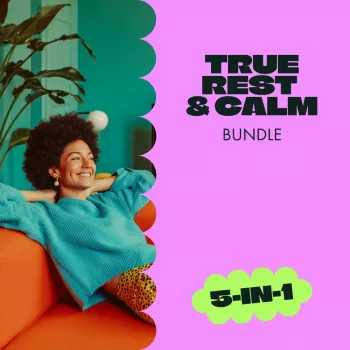
The Essential Relaxation Toolkit for Inner Peace: 5-in-1 Bundle for True Rest & Calm is designed to make calm practical and repeatable: quick resets for stressful moments, deeper wind-down routines for evenings, and simple tracking so progress feels real instead of vague.
What “true rest” looks like day to day
Rest vs. distraction comes down to results: after true rest, the body feels less braced and the mind feels less noisy. Distraction may pass time, but it often leaves the nervous system revved up—especially after too much screen input.
Common signs you need a reset include irritability, trouble concentrating, a tight jaw or shoulders, shallow breathing, and that “tired but wired” feeling where you’re exhausted but can’t settle. A realistic goal isn’t perfect calm; it’s shifting from constant activation into short, frequent downshifts that build steadier ease over time.
| State | How it feels | Helpful approach |
|---|---|---|
| Overstimulated | Racing mind, sensory overload, snappy mood | Reduce inputs; short breath practice; grounding exercise |
| Tired but wired | Exhausted yet unable to settle | Longer wind-down; gentle body scan; consistent bedtime routine |
| Burned out | Flat motivation, emotional numbness | Low-demand self-care; micro-rest breaks; supportive boundaries |
| Anxious | Worry loops, tight chest, restless body | Reassurance cues; paced breathing; journaling prompts |
For a science-backed overview of relaxation methods, see the National Center for Complementary and Integrative Health (NCCIH) guide to relaxation techniques. For how stress shows up physically, the American Psychological Association (APA) explains stress effects on the body.
What’s inside the 5-in-1 relaxation toolkit bundle
This bundle is a guided set of resources meant to be mixed and matched depending on the moment—think quick resets when you’re overloaded and deeper unwinds when you’re transitioning into sleep. The most sustainable approach is simple progression: start with the shortest practices, then layer longer routines once they feel familiar.
The focus stays practical: prompts, checklists, and repeatable exercises that make calm actionable rather than abstract. A helpful starting structure is to choose one core practice for mornings, one for high-stress moments, and one for evenings for two weeks before changing anything.
| Time of day | Duration | Goal | Example practice |
|---|---|---|---|
| Morning | 3–5 min | Set a calmer baseline | Breathing + intention prompt |
| Midday | 2–4 min | Release tension | Shoulder/jaw scan + grounding |
| Evening | 10–15 min | Downshift for sleep | Body scan + short reflection |
| High-stress moment | 60–120 sec | Interrupt spiraling | Name-5-senses grounding + slow exhale |
A 10-minute “micro-rest” routine for busy days
When you can’t take a long break, aim for a short sequence that signals safety to the body. Micro-rest works best when it’s consistent and low-effort—something you can do at a desk, in a parked car, or in a quiet corner.
Minute 1–2: Reduce stimulation
Put your phone face down, lower brightness, and remove one noise source (mute notifications or step away from chatter). Less input gives your attention room to settle.
Minute 3–5: Paced breathing (longer exhale)
Inhale gently, then exhale a little longer than you inhale. Don’t force big breaths—think smooth and quiet. Longer exhales are often more settling than “deep breaths.”
Minute 6–8: Tension release scan
Minute 9–10: Close the loop
| Step | Done? |
|---|---|
| Reduce stimulation for 2 minutes | □ |
| Paced breathing for 3 minutes | □ |
| Tension scan for 3 minutes | □ |
| One-sentence reflection + next action | □ |
Building inner peace: the calm habits that actually stick
For sleep-friendly structure, the National Sleep Foundation’s healthy sleep tips can help reinforce the basics alongside a consistent wind-down.
Who this bundle is best for (and who may want something different)
How to get started in 24 hours
Bundle details at a glance
Product: The Essential Relaxation Toolkit for Inner Peace: 5-in-1 Bundle for True Rest & Calm
Price: $316.99 (USD)
Availability: In stock
| Field | Value |
|---|---|
| Name | The Essential Relaxation Toolkit for Inner Peace: 5-in-1 Bundle for True Rest & Calm |
| Price | 316.99 USD |
| Availability | In stock |
| Product page | View product |
More in-stock toolkits to support a calmer, stronger routine
- Muscle Sculpting Toolkit for Women: Sculpt & Shred Guide, Checklist, and More (in stock) — helpful if stress relief and strength-building work best together.
- Kids Finance Toolkit: From Allowance to Awareness | 3 in 1 Bundle of Money Guides & Checklists (in stock) — useful for reducing family money stress by adding simple systems and routines.
- Apartment Market Playbook for Serious Investors | 5-in-1 Apartment Investing Guides & Tools (in stock) — for those who feel calmer when plans and decision-making are organized.
FAQ
How fast can results show up from a relaxation routine?
Some relief can show up in minutes (slower breathing, less muscle tension), while a steadier baseline of calm usually builds over 2–4 weeks. Small daily reps matter more than occasional long sessions.
Can this help with sleep if the mind won’t shut off at night?
Yes—using a predictable wind-down, longer-exhale breathing, and a short reflection prompt can help your brain “offload” thoughts before bed. If insomnia is persistent or severe, consider clinical support alongside self-guided routines.
What if meditation makes anxiety worse?
Try grounding and body-based options (a senses check or gentle tension scan) and keep sessions short. Stop or modify the practice if symptoms escalate, and consider professional guidance if anxiety remains intense.














Leave a comment